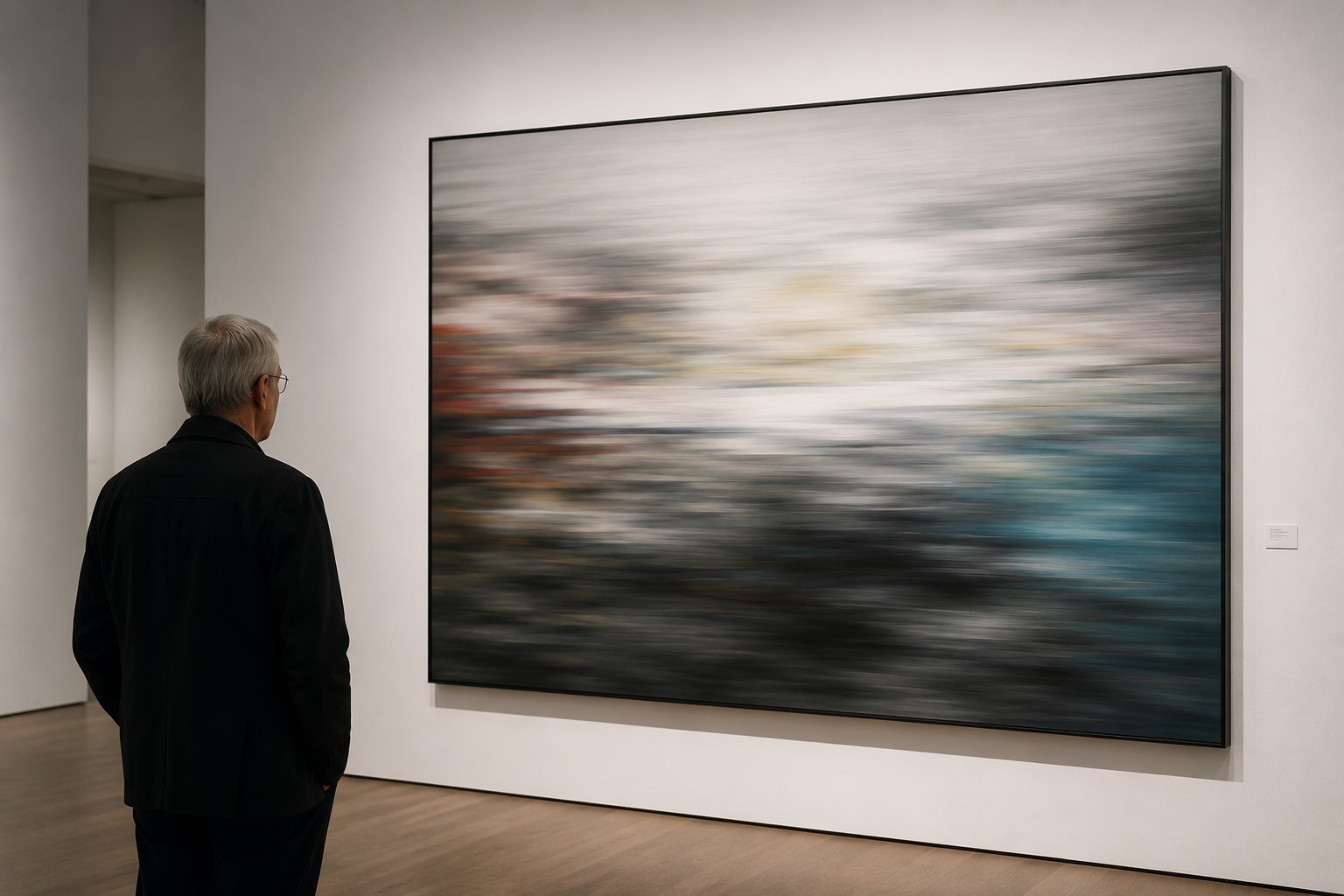
Gerhard Richter Explores the Uncertainty of History Through His Iconic Blurred Paintings
For decades, Gerhard Richter has challenged conventional ideas about memory, truth, and historical representation through his distinctive blurred paintings. Rather than presenting the past as clear and fixed, Richter’s work suggests that history is often fragmented, ambiguous, and open to interpretation.
One striking example is Garmisch (1981), a painting depicting the Bavarian Alpine resort town of Garmisch-Partenkirchen. At first glance, the scene appears calm and picturesque, capturing the beauty of a winter landscape. Yet beneath its tranquil surface lies a complex historical narrative.
The town is known not only for its scenic mountain setting but also for its connection to the 1936 Winter Olympics. The event took place during the rise of Nazi Germany, and Adolf Hitler personally attended the Games’ opening ceremonies, just as he did later that year at the Berlin Olympics. This historical backdrop transforms the seemingly ordinary landscape into a site loaded with political and historical significance.
Richter’s signature blurring technique plays a crucial role in how viewers engage with the painting. The softened image obscures details and creates a sense of distance, reflecting the way historical events are often remembered through incomplete records, fading memories, and conflicting interpretations. Rather than offering definitive answers, the painting invites viewers to consider what lies beneath the surface of familiar places and images.
Throughout his career, Richter has frequently drawn from photographs, archival materials, and historical events, using paint to question the reliability of visual evidence itself. His works often explore the tension between what is seen and what is known, encouraging audiences to examine how history is constructed and remembered.
In Garmisch, the blurred landscape becomes more than a depiction of a location. It serves as a meditation on memory and the complexities of the past, reminding viewers that even the most beautiful scenes can carry hidden histories.
By refusing to present history in sharp focus, Richter’s art challenges the notion of absolute truth. Instead, his paintings suggest that understanding the past requires acknowledging uncertainty, ambiguity, and the limits of human perception.
As one of the most influential contemporary artists of the modern era, Richter continues to demonstrate that history is rarely straightforward. Through his iconic blurred paintings, he invites viewers to look beyond appearances and reflect on the fragile relationship between memory, art, and historical truth.

Comments (0)
Sign in to join the conversation.