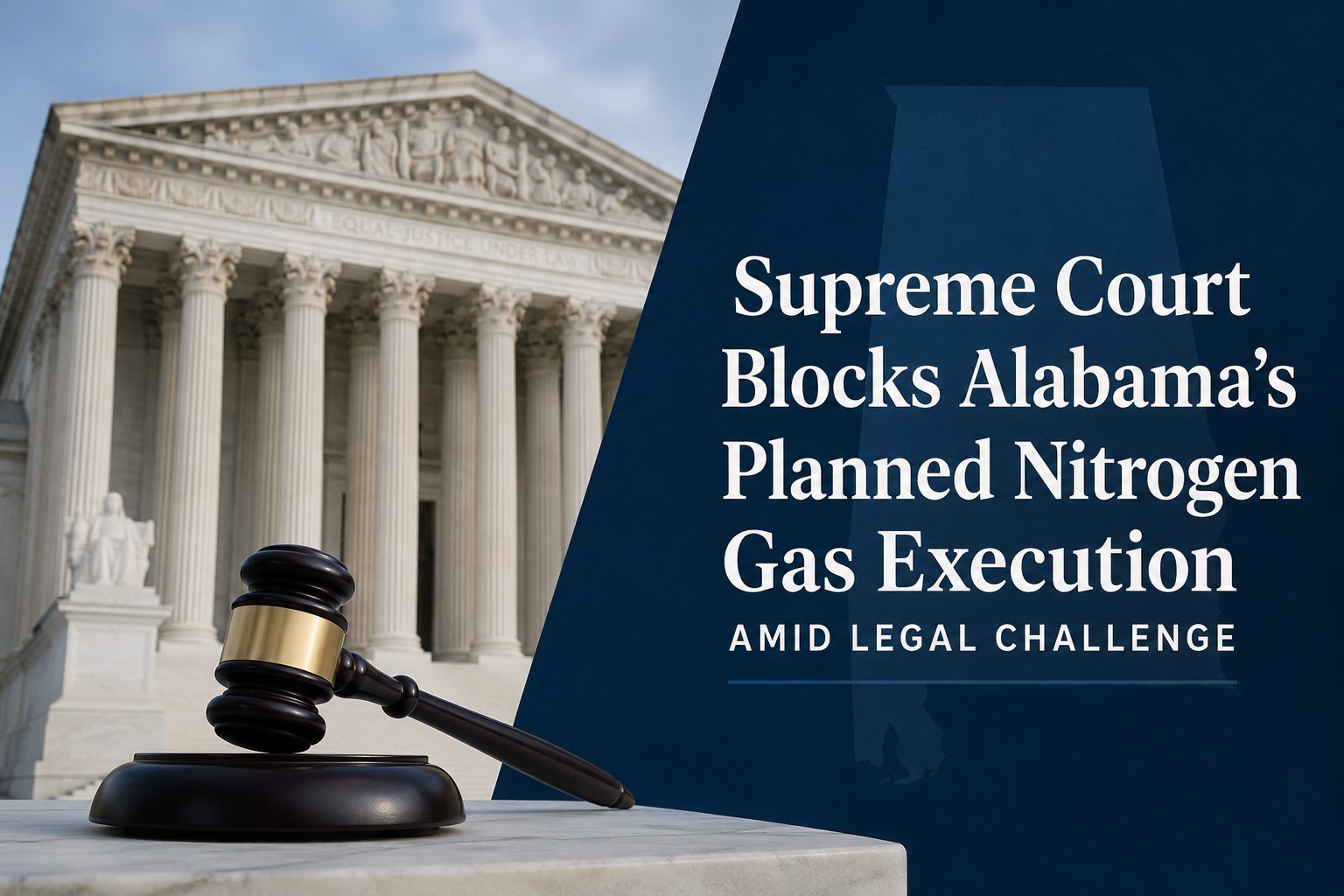
Supreme Court Halts Alabama’s Planned Nitrogen Gas Execution of Death Row Inmate
The U.S. Supreme Court on Thursday night blocked Alabama from carrying out the scheduled execution of death row inmate Jeffery Lee, delivering a significant legal setback to state officials and raising fresh questions about the future of nitrogen gas executions in the United States.
The decision came after Alabama officials sought emergency intervention from the nation’s highest court following a lower federal court ruling that found the planned use of nitrogen hypoxia was likely unconstitutional under the specific circumstances of Lee’s case.
In a brief, unsigned order, the Supreme Court declined Alabama’s request to proceed with the execution. As is common in emergency rulings, the court did not provide an explanation for its decision. Three conservative justices — Clarence Thomas, Samuel Alito, and Neil Gorsuch — dissented from the ruling.
Alabama had planned to execute 49-year-old Jeffery Lee at 6 p.m. Thursday. The execution would have made him the eighth inmate in Alabama and the ninth nationwide to be put to death using nitrogen hypoxia, a controversial execution method that deprives the body of oxygen by administering pure nitrogen gas.
The case represents a major test of the legality of nitrogen hypoxia, a method Alabama first used in 2024. Supporters argue that the procedure is a lawful alternative to lethal injection, while critics contend that it raises serious constitutional and ethical concerns.
Legal experts note that the Supreme Court rarely intervenes to stop executions at the final hour. In most cases, death row inmates directly petition the court for emergency relief. In this instance, however, a federal appeals court had already blocked the execution, prompting Alabama officials to ask the Supreme Court to overturn that ruling.
The court’s decision leaves Lee’s execution on hold and could pave the way for broader legal challenges surrounding the use of nitrogen hypoxia in capital punishment cases across the country.
Following the ruling, Lee expressed relief during a phone call with his mother, celebrating the court’s decision to halt the execution.
The case is expected to remain closely watched as courts continue to examine whether nitrogen gas executions comply with constitutional protections against cruel and unusual punishment.

Comments (0)
Sign in to join the conversation.