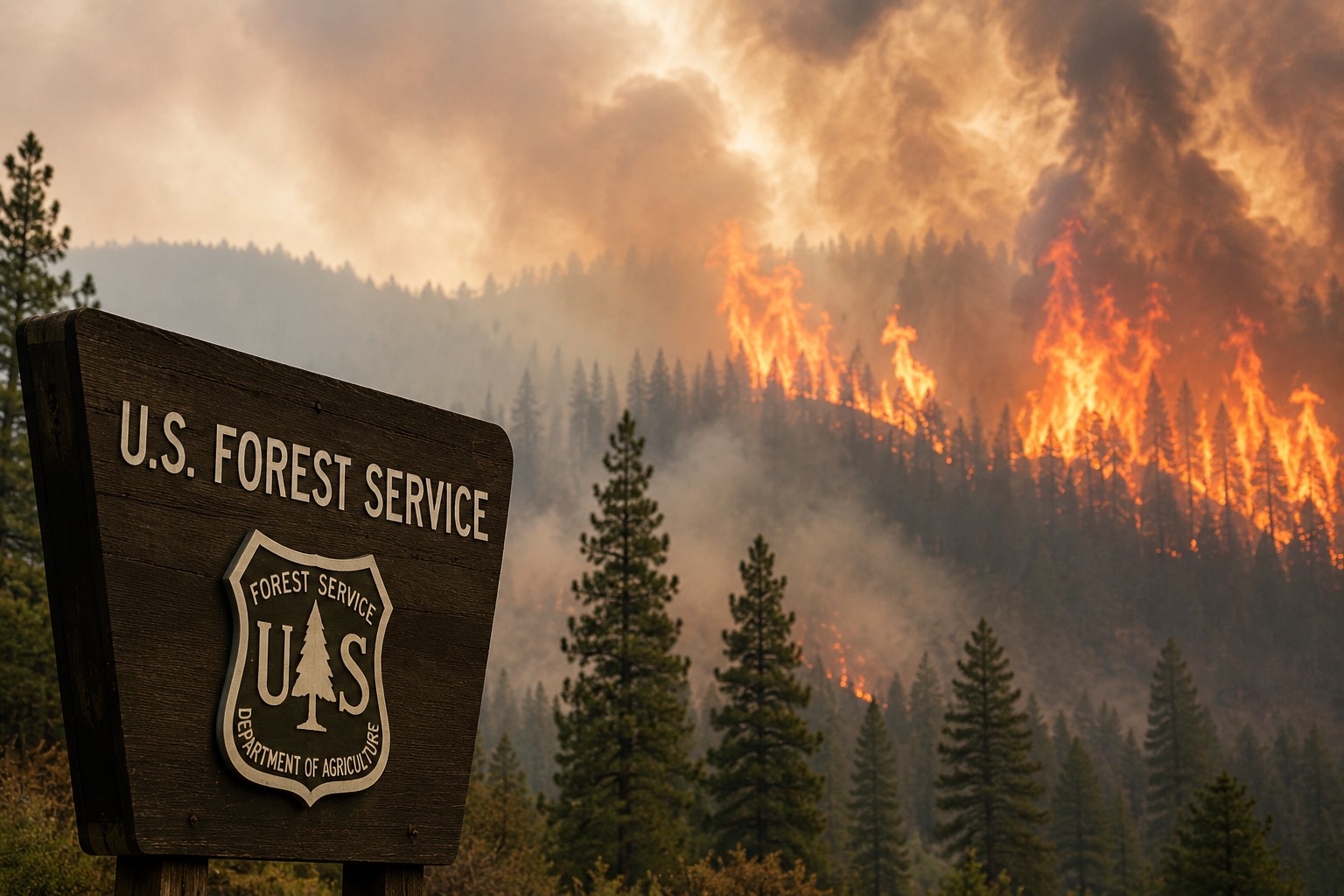
Trump Administration Targets Forest and Wildfire Research as Western Fire Season Intensifies
As the western United States prepares for what could be another severe wildfire season, scientists and public officials are raising concerns over proposed federal cuts to forest and wildfire research programs that have long supported fire prevention, smoke forecasting, and emergency response efforts.
The concerns are particularly evident at the University of Washington (UW), one of the nation's leading recipients of federal research funding. With the Trump administration already reducing funding for major scientific agencies such as the National Science Foundation and the National Institutes of Health, uncertainty is spreading across research institutions, including programs focused on wildfire science.
At UW's School of Environmental and Forest Sciences, researchers warn that planned restructuring within the U.S. Forest Service (USFS) and potential budget reductions could weaken critical research capabilities just as wildfire threats are increasing across the West.
"We have a wildfire crisis in the West and across the United States," said Ernesto Alvarado, a fire ecologist and associate professor at UW.
Alvarado helped develop a real-time wildfire smoke monitoring system in collaboration with scientists at the Pacific Wildland Fire Sciences Laboratory. The platform tracks wildfire smoke movement, air quality conditions, and harmful particulate concentrations, providing valuable information to governments, firefighting agencies, and the public.
The technology, developed through decades of Forest Service research, has become an important tool for communities facing worsening wildfire seasons. Researchers say such long-term institutional knowledge cannot easily be replaced by short-term academic grants.
However, the Seattle-based smoke research laboratory is among dozens of facilities identified for possible closure under the Forest Service's proposed reorganization plan. The restructuring would consolidate regional offices, relocate the agency's headquarters from Washington, D.C., to Utah, and potentially move researchers to new locations.
Former Forest Service fire behavior scientist Morgan Varner said the changes could result in the loss of experienced personnel and disrupt ongoing scientific work.
"Seattle is a technology hub," Varner said. "This lab works with some of the brightest research minds in the country. Many employees may not be willing or able to relocate."
Forest Service Chief Tom Schultz has defended the reorganization, arguing that the agency must address a significant maintenance backlog and operate more efficiently. He emphasized that scientific research remains a priority despite concerns about potential closures.
"We aren't closing research," Schultz said. "Science is extremely important in this organization."
Schultz noted that some researchers may simply be relocated to nearby offices and said the administration is attempting to manage budget challenges while maintaining essential functions.
Yet questions remain about the future of wildfire science. President Trump's proposed budget would eliminate Forest Service research and development funding entirely, though Congress ultimately controls federal spending. Lawmakers from both parties have expressed reservations about the proposal during recent hearings.
If Congress were to approve the administration's budget request, experts warn that the Forest Service could face significant reductions in capacity at a time when climate change is contributing to more frequent and severe wildfires across the country.
The agency has already experienced workforce reductions through layoffs, buyouts, and early retirements, adding to concerns among researchers, firefighters, and local communities that rely on Forest Service expertise.


Comments (0)
Sign in to join the conversation.