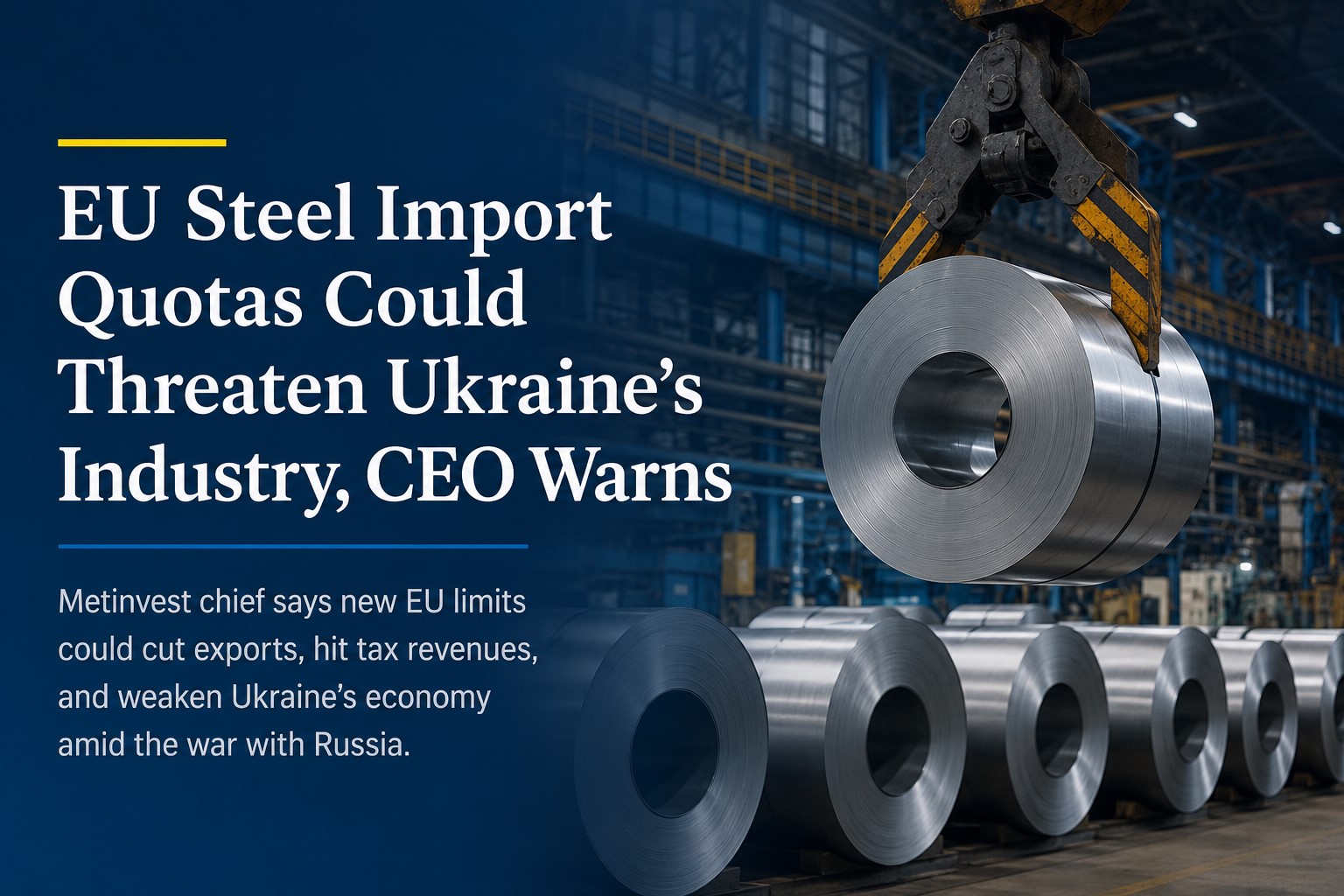
EU Steel Import Quotas Could Threaten Ukraine’s Steel Industry, Industry Leader Warns
Ukraine’s steel industry could face severe economic consequences under new European Union import restrictions, according to the head of the country’s largest steel producer.
Yuriy Ryzhenkov, chief executive of Metinvest, has warned that a new EU quota system scheduled to take effect on July 1 could significantly damage Ukraine’s steel sector at a time when the country is already under immense pressure from its ongoing war with Russia.
The EU recently introduced stricter safeguards on steel imports in response to a prolonged global oversupply, largely attributed to increased production from China. Under the revised rules, tariff-free steel import quotas have been reduced, while imports exceeding allocated quotas will face a steep 50% tariff.
The changes have prompted concerns among steel-producing nations seeking to secure access to the European market. Industry representatives across Europe, including the United Kingdom, have raised alarms about the potential impact on exports and competitiveness.
For Ukraine, however, the stakes are particularly high. Since Russia’s full-scale invasion in 2022, Ukrainian steelmakers have lost access to several traditional export markets and have increasingly relied on Europe as a key destination for their products.
Ryzhenkov argues that Ukraine’s steel industry does not pose a significant competitive threat to European producers and believes the new restrictions fail to account for the extraordinary circumstances facing the country.
He warned that reducing steel exports could also weaken Ukraine’s economy by cutting tax revenues generated by one of the nation’s most important industries. Metinvest, owned by businessman Rinat Akhmetov, is considered one of Ukraine’s largest private taxpayers and a major contributor to the country’s budget.
The industry is also preparing for additional challenges linked to the EU’s Carbon Border Adjustment Mechanism, which places costs on imports produced using higher-emission manufacturing methods. While Metinvest had previously planned major investments to modernize its facilities and reduce emissions, the ongoing conflict has made such projects financially difficult.
Despite the challenges, Metinvest continues to operate its steel plants near Zaporizhzhia and Kamianske, although both facilities are functioning below full capacity. Production has been affected by repeated attacks on infrastructure, disruptions to rail transport, and instability in the electricity network caused by Russian strikes on Ukraine’s energy system.
The company has already suffered significant losses during the war, including the destruction of its major steelworks in Mariupol and the loss of access to important mining operations in eastern Ukraine.

Comments (0)
Sign in to join the conversation.